The art historian and curator Germano Celant once observed that Haim Steinbach was setting up a “horizon-line of ‘figures’” on the shelf. He also recalled the game of chess played between the knight and death in Ingmar Bergman’s film The Seventh Seal. Celant was referencing Bergman’s existential narrative with the chess board and its grid of quasi-objects in relation to Haim Steinbach’s play.
In 1976, Haim Steinbach conceived of the as if game board with his series of works titled Particle Board with BlackShapes. Using a black oil stick he rubbed geometric shapes onto a 2’ x 2’ particle board. They were placed along the four edges of the square panel like pawns, graffiti, or even chords of the musical scale.
By the mid-1980s, two conceptual devices came into focus in Steinbach’s practice. One is now so widely recognized that it has become paradigmatic; the Minimalist wedge shelf, with its variable scale and strict proportions offering a platform for the selection and arrangement of objects. The other is his work with found texts. Steinbach texts are found objects redeployed with their original typefaces intact and applied in vinyl directly to the wall. The character of the words and their typefaces gives them a dimension of orality that is crucial to their meaning. We hear them when we see them. This becomes explicit in a work like beep honk toot, originally presented in 1989 as a wall text in the exhibition AForest of Signs: Art in the Crisis of Representation at the Museum of Contemporary Art in Los Angeles. It is now being shown here in the exhibition.
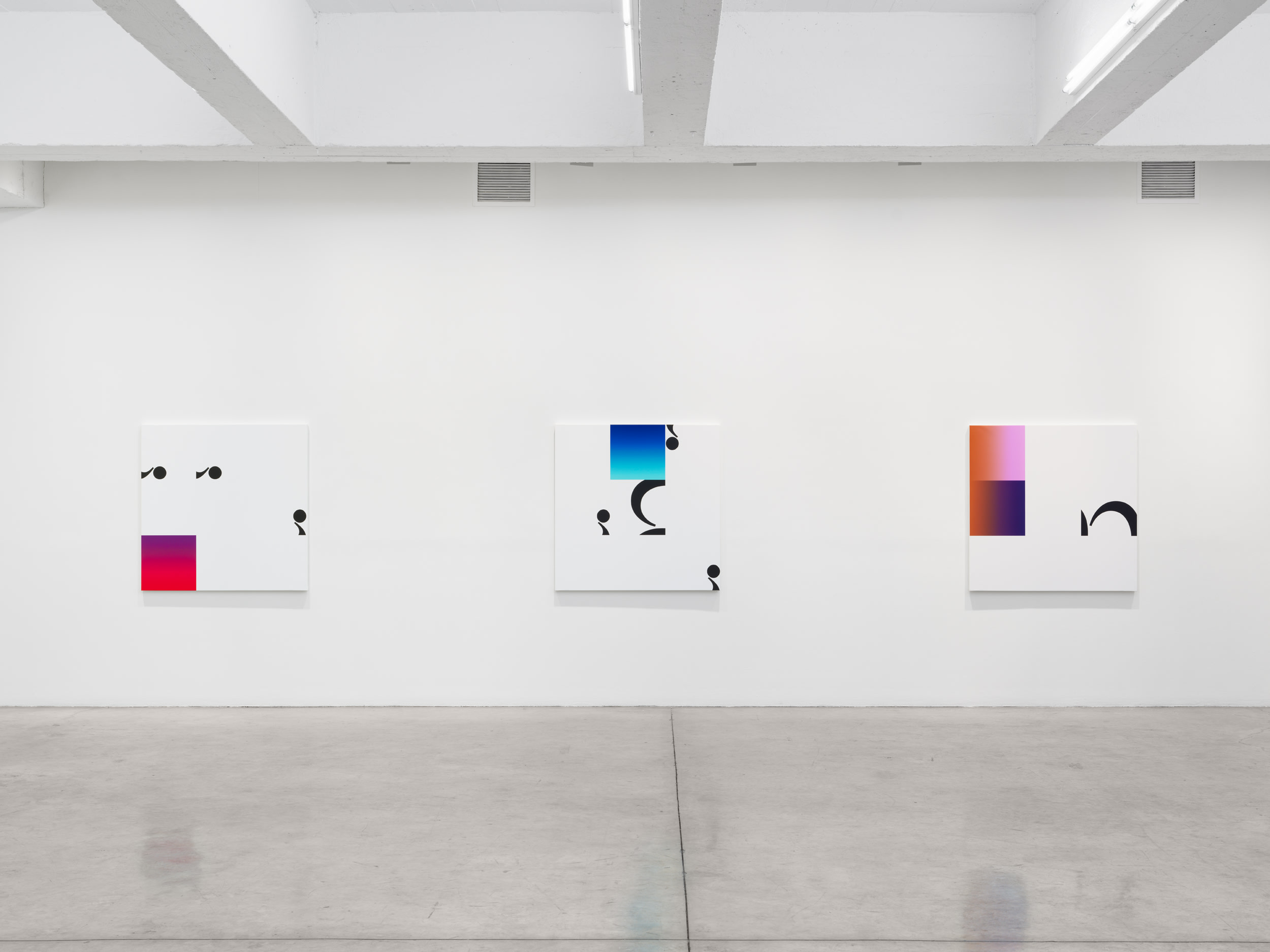
In five easy pieces, Steinbach introduces a new game format for his works: the “condensed” wall text and the ”condensed/spectrum” canvas works. His hello again (condensed) (2025) is based on the wall text hello again, exhibited in 2019 at the reopening of the Museum of Modern Art in New York. The arrangement of the black and white text itself has been digitally fragmented and reorganized through a repetitive throw of the dice.
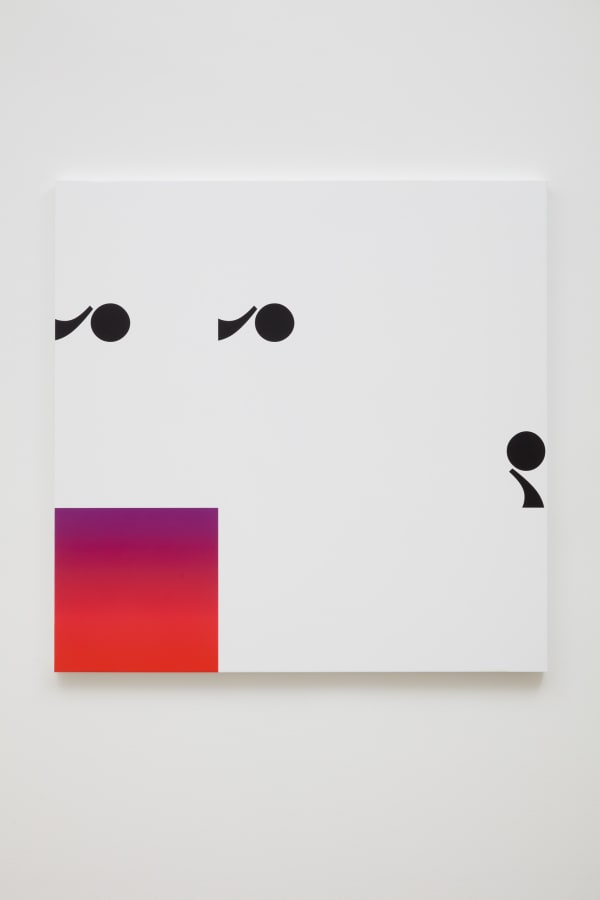
Several new canvas works titled beep honk toot (condensed/spectrum) include color. They are based on the original beep honk toot (1989) wall text. Each canvas is structured by a three-by-three grid of nine square tiles. Approached as if a game board, the fragmented pieces of the font fall into the tiles, in part with the use of a random number generator. Some color spectrum tiles are integrated in the digital mixing process.
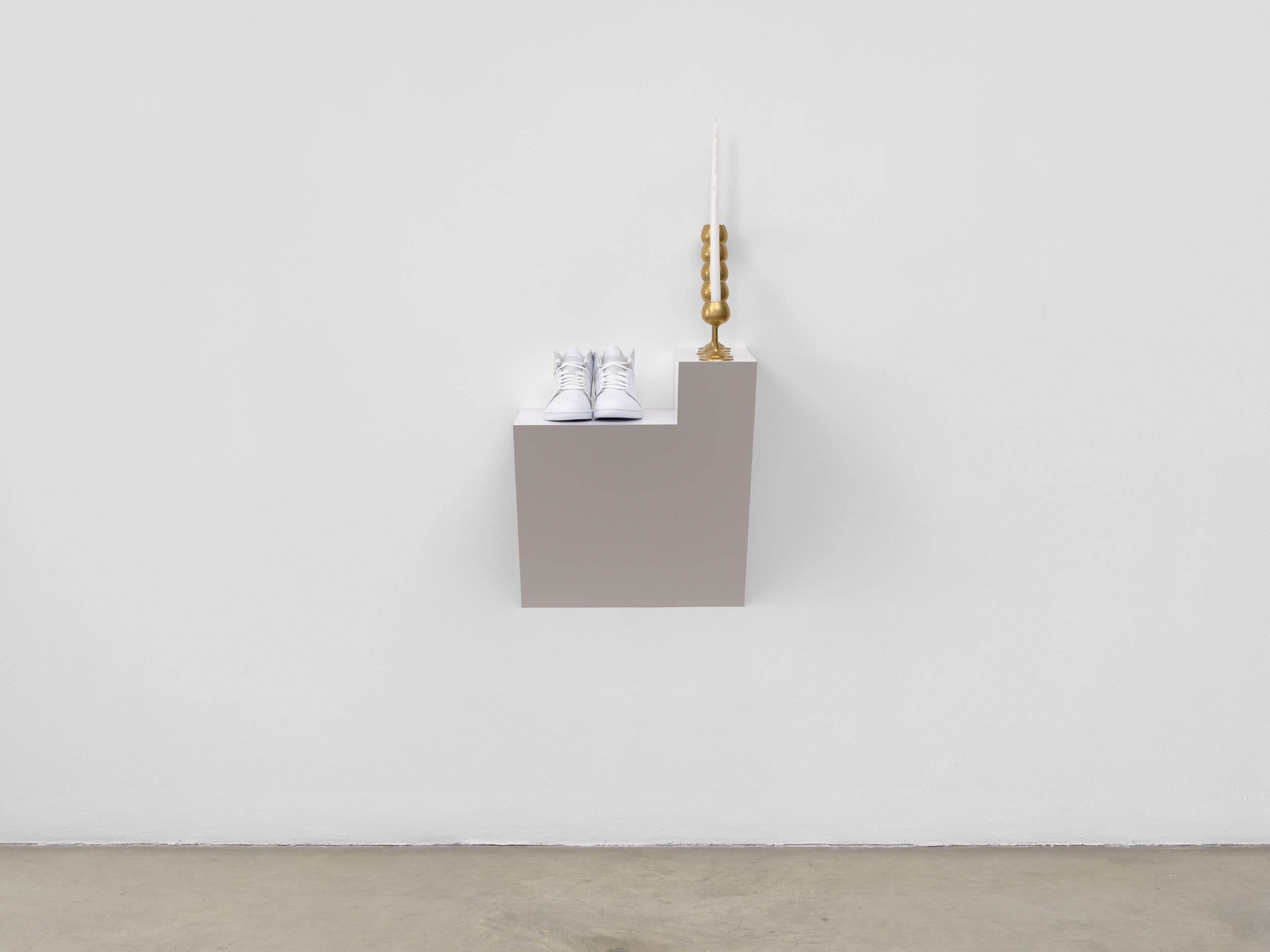
In the present exhibition a new variant of the wedge shelf, relatedand different (1985) is on view. Like the original two-tiered colored shelf, it displays a pair of basketball sneakers and five brass candlesticks that are scaled from the shortest to the tallest. But now the shelf and shoes are rendered in white. Over the years there have been many interpretations to the meanings of Steinbach’s selection and arrangement of objects. The authors of the Thames and Hudson publication “Art Since 1900” (2004) projected the arrangement of the candlesticks and sneakers to be “plastic goblets” and “the Holy Grail.” In his essay “Rituals in Exhibition,” philosopher Mario Perniola reflected on Steinbach’s practice as it applies to the ritualistic dimension of our everyday relation to objects. Art historian and curator Johanna Burton pointed to “the brute material fact of what’s actually there,” and Object-Oriented Ontology philosopher Timothy Morton observed that “there is an inviolable gap between what things are and how they appear.”