• SHILPA GUPTA

  • For more than three decades, Shilpa Gupta has explored the structures through which belonging is produced, recognized, and regulated. Resisting fixed categories and expectations, Gupta has consistently challenged and reimagined borders, whether territorial or artistic. Her work explores how familiar forms come to carry authority, shaping ideas of belonging while determining what remains outside them. In turn, these works expose the often unseen structures through which power is exercised and maintained.
     
    Gupta’s encounters in border regions shaped an engagement with maps and flags, recurring motifs that reveal the nation state to be a comparatively recent formation when viewed against longer histories of human movement and shared cultural life. Through meticulous acts of collection, tracing, counting, dissection, and reconfiguration, Gupta unsettles the authority of stars, maps, and flags, revealing how such symbols come to acquire meaning and legitimacy.
  • book of map drawings

    100 Hand-drawn Maps of USA

    These hand-drawn maps are part of an ongoing series in which Shilpa Gupta asks one hundred people to make a map of the country by memory. 


    On this occasion, she asked people to draw an outline map of the United States purely based on memory. There is no single drawing that is “accurate,” nor are there two that are the same. States are forgotten, misshaped, or incorporated into others highlighting the disparity between the private and the public, between the singular state-sanctioned cartography and the informal image of one’s country that one carries in the mind. 

  • Across this group of works, invisible structures of power are made tangible, revealing how acts of demarcation shape both individual lives and collective identities. Yet Gupta’s practice is equally attentive to the flows that evade such systems of control. Through the creation of archives of everyday objects smuggled across border fences, she examines desire, mobility, and ethics in the face of laws and censorship, asking who gets to regulate movement and exchange, and under what terms.
  • detail of embroidery

    Stars on Flags of the World

    A monumental, embroidered canvas portrays the stars on the flags of recognized and unrecognized nations. The flag, a symbol of power and identity, of strength and stability, is transformed into fine, delicate thread, suggesting the instability of the nation-state, usually seen as predetermined and unshakable. Gupta questions the concept of the  “homeland", and how national identity is determined in border areas where everyday life is shaped by historical and social affinities, geographical continuity, and economic imperative. Here, the stars usually portrayed on separate flags are gathered together on one, ideal flag, where the different symbols are overlap, erasing in turn their individual meanings, breaking down codes, boundaries and borders.
  • Acts of winding, stacking, drawing, tracing, collecting, and carrying recur throughout the works. They evoke forms of movement that precede political boundaries and persist despite them, connecting the terrain of the land with that of the body. By deconstructing and reconfiguring the visual language of the nation state, Gupta invites us to look beyond the lines that divide us and to imagine belonging as something more expansive than the territories we inherit.
  • detail image of thread ball

    1:7690

    “The very act of continuous winding into a single whole, where a ball is held and turned around again and again embodies a range of emotions—hysteria, anxiety, and hope, which vanish to reappear when lines drawn through neighborhoods and sometimes literally through homes continue to simmer.” 

    - Shilpa Gupta


    The work is composed of a hand-wound ball, made from shredded strips of an everyday garment hand-carried to India from Bangladesh, that forms part of the informal and subversive economy that persists despite the border fencing. The garment is no longer recognizable, a tactic often used in contraband as well. This conscious abstraction is further manifested in the artwork's title, which serves to underscore the arbitrary nature of state-sanctioned cartography.


    When multiplied by the ratio indicated in the title, the length of the fabric strips corresponds to the measurement of the fenced border between the two nations. She juxtaposes ideas of empirical measurement used to construct border lines against ground reality. 

  • detail of wooden blocks work

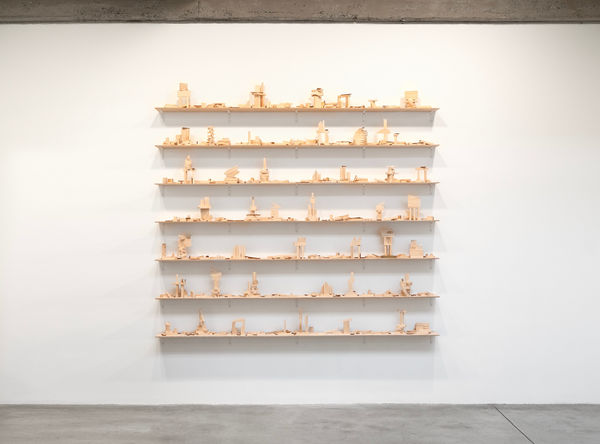
    Untitled (flags of the world)

    In this work, Shilpa Gupta disassembles national flags into discrete symbols and blocks of shapes, several of which bear uncanny resemblance to one another. Like a set of wooden blocks that reminds of a Jenga game, the pieces are grouped together to create new configurations that blur or reimagine the original geopolitical relations. 


    While flags are closed systems that are codified (you are not allowed to be creative with them), Shilpa brings an element of open-ended-ness into this work, suggesting that they could be fluid and interchangeable.

  • Together, these works reveal the distance between lived experience and the systems used to classify it. They foreground questions of power and recognition while tracing the ways people, objects, and aspirations move across and transgress boundaries. Again and again, the works return to what escapes containment.
     
    Shilpa Gupta currently has a solo exhibition titled What Still Holds at Hamburger Bahnhof in Berlin, Germany, on view through January 3, 2027.