• Art Basel Miami Beach

  • scale image of uta barth

    UTA BARTH

    For almost three decades, Uta Barth has made visual perception the subject of her work. Barth’s Deep Blue Day series explores notions of the atmospheric and ephemeral through light as it shifts over time. Here, Barth overtly manipulates her surroundings by drawing the folds of her living room curtains in order to shape shifting rays of sunlight over the course of an afternoon. While photography is always about light and exposure, this work is a beautiful example of Barth’s engagement with light, where she uses it in an almost sculptural or performative way.

  • Math Bass detail of painting

    MATH BASS

    Math Bass has developed a lexicon of symbols—letters, bodily forms, architectural fragments, animals, bones—arranged in a variety of scores, each symbol an empty space of meaning, filled in by the context in which it finds itself. Repetition of these symbols, rather than codifying them into one solid signification, exposes the difference at the heart of each iteration; there is always a gap in meaning, something unnamable left out of and left over in the viewer’s reading—a jouissance. It is this gap in the symbolic where Lee Edelman states queerness lies—not as an easily categorized liberal identity but as a process of unmaking and undoing that leaves (gendered) subjectivity as we know it in question. That these symbols are familiar only heightens our unsettling; the negative space of these compositions, a major player in Bass’s practice, adds further to the gap.

  • monica scale image

    MONICA BONVICINI

    For over three decades, Monica Bonvicini’s multifaceted practice has confronted issues of institutional critique and the politics of space in relation to gender and power. Excite Me (celeste) continues her long-standing exploration of literature and poetry, drawing on passages that resonate with her personally. These typographical works use a complex technique of layered lacquer that simulates a wet surface, mirrored as to implicate the viewer within its sentiment.

  • detail of cinto painting

    SANDRA CINTO

    Sandra Cinto’s fine brush draws intricate navy mountains and blue clouds onto a gradient gold background. These delicate motifs appear across her works, populating her lyrical worlds. Cinto’s seemingly weightless environments hover gently between fantasy and reality, creating a luminous plane where anything is possible.


    The artist’s solo exhibition is on view at Tanya Bonakdar Gallery, New York through December 18, 2026.

  • Eliasson mirrored wall work

    OLAFUR ELIASSON

    A single horizontal array of overlapping ellipses and circles unfurls across the wall. The progression moves from flattened, elongated ellipses at either end towards near-perfect circles at the centre, evoking the illusion of a series of discs balanced vertically on their edges and floating in space in a three-dimensional ring. The mechanism behind this illusion rests on a simple visual ambiguity: depending on the context, ellipses may appear to be circles viewed in perspective. The ring of twelve circles, each a different colour, progresses through the full spectrum of visible light. The appearance of transparency – the sense that one can see the far side of the ring through the large circle in the foreground – is simulated by introducing shapes of intermediary hues wherever the discs overlap. The backs of the glass are silvered, so that they reflect the viewer and their surroundings in the distinctive shades of each pane. The handblown panes of glass exhibit natural ripples and bubbles that distort the reflections subtly and contribute to an overall feeling of luminosity and movement.


    The artist’s work is currently on view at Hamburger Bahnhof, Berlin through June 27, 2027.

  • rodrigo brass detail

    RODRIGO HERNÁNDEZ

    Rodrigo Hernández’s Reconocimiento is a hand-hammered brass sculpture that captures artist’s dream-like imagery and conveys the intimacy of the moment depicted. While the luminous surface appears etched and carved, in reality, brass sheets have been layered and attached with fasteners to create a subtly sculpted plane. Hernández’s fantastical visual lexicon is rooted in a wide and distinctive range of sources: from Mexican pre-Columbian art to Japanese prints, from European modernism to science and literature. Simmering with the emotional power of subconscious memory, the artist's works are suffused with the attraction of the unknown.

  • LAURA LIMA

    LAURA LIMA

    For thirty years, Lima has developed an idiosyncratic and entirely unique philosophical language. With a tendency towards the absurd and the sensational, she allows the audience to lose themselves in this potential for change. Laura Lima's Balé Literal is an exhibition in motion — objects and artworks are 'dancers' animated by a pulley system in a choreography of the absurd. Using wire, colored glass, cutlery, string and cords, Lima puts forward an ecstatic dialectical gambit.

  • scale of rita painting

    RITA LUNDQVIST

    An exquisitely rendered group of new oil paintings on panel pull the viewer into Rita Lundqvist’s enigmatic world of stillness and silence. With relentless consistency, the intimately scaled compositions feature a familiar vocabulary of figures and objects that appear engaged in mysterious activities. In Lundqvist’s work, the focus is always composition and color, with flattened forms and a subdued palette, imbuing them with a sense of sublimity. The spare scenes and scale of the works leave space for quiet contemplation.


    Rita Lundqvist’s solo exhibition is on view at Tanya Bonakdar Gallery, New York through December 18, 2026.

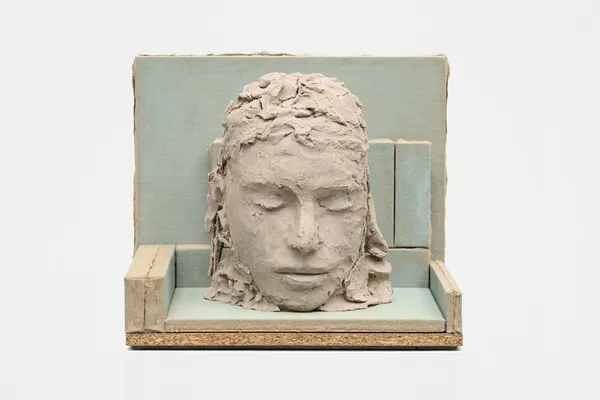
  • manders sculpture with scale

    MARK MANDERS

    Remarkable in execution and detail, Fragmented Painting is produced through an intimate logic that has now become signature to Manders' practice. Rendered in cast bronze, the sculptural portrait appears to be soft clay mid-way through the process of becoming a sculpture. In casting the sculpture in bronze, the artist freezes a very specific moment in time, highlighting the fragility of every moment that passes. The manipulation of material generates a sense of puzzlement and awe, masterfully creating a sense of timelessness - while the sculpture seems to be just made, it is at the same time enigmatically atemporal. Mark Manders’ work is currently on view at the Fondazione Palazzo Strozzi, Florence, Italy through January 24, 2027.

  • detail of yuko mohri

    YUKO MOHRI

    In Yuko Mohri’s Decomposition series, she inserts electrodes into fruit to measure their internal moisture levels and converts changes in resistance into light. The work translates minuscule changes occurring inside fruit into flickering lights, conveying the life of fruit that continues to emerge and evolve even after its connection to the soil or tree trunk has been severed. Hinting at the history of still-life painting, Mohri’s work questions the relation between stillness and liveliness, revealing that what might seem without life is actually full of it. As the fruits dry over time, the fruitsʼ resistance grows, and consequently the lights flicker. Yuko Mohri’s work is currently on view in her solo exhibitions at The Bass Museum of Art, Miami and The Barbican Centre: The Curve, London.

  • detail of neto

    ERNESTO NETO

    This work demonstrates Neto's use of crochet as a formal and symbolic element, transforming a small-scale artisanal craft into a large-scale sculptural action. The slow, collective activity is precisely planned yet organic, verging on ritualistic, as yet another powerful expression of Neto's enduring artistic inquiry. Here, a dynamic pattern emerges from an intricately crocheted web, traversing both two and three dimensional planes through the use of bamboo trusses.


    Ernesto Neto’s work is currently on view at the Centro Cultural Veras, Florianópolis, Brazil through April 10, 2027.

  • detail of lisa oppenheim photograph

    LISA OPPENHEIM

    In this series, Lisa Oppenheim explores the legacy of Edward Steichen (1879-1973), well-known for his photographic innovations and experimental approaches to flower-breeding. In 1910, botanist Fernand Denis created and named an iris hybrid "Mons. Steichen" after him, though no images or specimens survive. Steichen pioneered dye transfer printing in the 1930s, experimenting with unconventional color combinations to create vibrant, almost psychedelic images. In his spirit, Oppenheim used AI to generate hypothetical crosses between the parent iris species (Chameiris Alba and Iberica). She then produced analog prints of the AI-generated images using the labor-intensive and almost entirely outmoded dye transfer process. Using nonstandard colors, she created diverse interpretations of the lost "Mons. Steichen" hybrid that explore the concept of both genetic and photographic verisimilitude. 


    Lisa Oppenheim’s work is currently on view at the University of Maryland, Baltimore, MD through December 18, 2026.

  • pica detail

    AMALIA PICA

    Amalia Pica’s Daisy Chain paintings come out of a collaborative installation made on site at Cample Line in Scotland, where Pica invited schoolchildren, visitors, and community members to make real daisy chains together. Those chains were dried, pressed, and installed as a 50-meter collective artwork. The result was a fragile-but-resilient artwork that brought people together through a small, joyful act. The socially constructed sculpture’ brings together Pica’s interests in memory, material culture, collective action and forms of common knowledge. Something as temporary and childlike as a daisy chain becomes, in Pica’shands, a model for how people build relationships and culture together. The daisy chain itself becomes a metaphor for how knowledge, traditions, and social bonds are passed between people.


    Amalia Pica’s solo exhibition, Lecturas Posibles, is on view at the Bass Museum of Art, Miami Beach through February 7, 2027.

  • powell scale

    DANA POWELL

    Dana Powell's small-scale oil paintings depict moments of transition and anticipation. They take the shape of night drives, full moons, swimming pools, elevator doors, still lifes with fruit, explosions, and peep holes. Unrelated at first look, these subjects prove malleable apparatus in demonstrating the unsettling power of the ordinary, and emotive potential of small shifts in formal painting strategies. Considered austerity is applied to Powell’s tableaus of the everyday, offering a window to the familiar and its undertow

  • detail of saban painting

    ANALIA SABAN

    Analia Saban explores the sculptural quality of paint, transforming two dimensional brushstrokes into three dimensional forms. A walnut frame acts as a loom and a framing device, whereby linen threads are woven around the frame’s vertical and horizontal axes creating a loose “canvas” in which dried acrylic impasto is embedded. In doing so, Saban challenges the traditions of the medium, separating canvas from paint to create a sculptural-painting hybrid.


    Analia Saban’s work is currently on view at TANK Shanghai through February 28, 2027. The artist also has a major solo presentation opening at the Los Angeles County Museum of Art, CA on March 14, 2027, which will later travel to the Kemper Art Museum.

  • saraceno detail image of glass

    TOMÁS SARACENO

    Aeolus stems from Tomás Saraceno’s long-standing artistic inquiry, Cloud Cities, where clouds perform as vital interlocutors between Earth, Atmosphere, and Sun. Their various morphologies carry with them messages of weather-presents and futures, guiding the fulfillment of our basic needs and shaping the spheres of our social, mental and environmental ecologies. In reflection, reality is revealed: the participant is inextricable from the surrounding environment in both cause and effect, melted, molded and sculpted, affected and affecting the viscous entanglement of the seen and unseen.


    Tomás Saraceno’s solo exhibition at the Haus der Kunst, Munich is on view through through February 7, 2027. The artist’s work is also on view at the Hamburger Bahnhof, Berlin through June 27, 2027.

  • detail of scheibitz painting

    THOMAS SCHEIBITZ

    Among the leading German artists of his generation, Thomas Scheibitz has developed his own conceptual language that bridges the realms of figuration and abstraction, at times dissolving them entirely. Drawing from classical painting and architecture, the contemporary urban landscape, and popular culture, Scheibitz deconstructs and recombines signs, images, shapes, and architectural fragments in ways that challenge traditional contexts and interpretations. While centrally concerned with principles of classification and systems of order, the artist’s paintings, sculptures and works on paper resist traditional categorization.

  • verso of Sandra Vasquez work

    SANDRA VÁSQUEZ DE LA HORRA

    With drawing as the foundation of her artistic practice, Sandra Vásquez de la Horra’s multidisciplinary work depicts the interconnectedness of the human body and the natural world. Taking inspiration from spiritual mythologies, folklore, religious iconographies, and Latin American popular imagery, she explores themes of the body, landscape, motherhood, gender, sexuality, and migration. Often dipping her works in beeswax or creating accordion-like paper sculptures, Vásquez de la Horra transforms them into three-dimensional objects, challenging the limits and possibilities of drawing.

  • scale image of lisa williamson

    LISA WILLIAMSON

    Interested in language and its inevitable abstraction, Lisa Williamson leans into the formal considerations of sculpture to create works that are visually precise, physically resonant, and often attune to the spaces in which they are exhibited. The artist’s idiosyncratic practice follows a logic that is associative; compressing internal experience into forms that are both tangible and resistant at once. While there is a significant level of reduction and abstraction throughout the artist’s work, aspects of architecture, landscape and the figure remain visible throughout.

  • NATHALIE DJURBERG & HANS BERG

    NATHALIE DJURBERG & HANS BERG

    Nathalie Djurberg and Hans Berg’s series of sculptural flowers offer a fragile beauty and an untamable, organic logic of their own. Constructed from mixed media – employing modelling clay, paint, fabric and resin – the sculptures recall real species of lilies or orchids, as well as fantastical floral arrangements in other-worldly colors and forms. Flowers recur in Djurberg & Berg’s practice due to their abiding interest in the fleeting nature of human emotions and their shared symbolism for human themes of love, joy, desire, sadness and vulnerability. Representing the circle of life, from a shy bud to a beautiful blossom to a withering plant, the flower form has been a constant interest in Djurberg and Berg’s practice.


    In 2009, the artists created their first major work inspired by flora and fauna, a subversively surreal and immersive Garden of Eden, entitled The Experiment, for the 53rd Venice Biennial, for which they were awarded the Silver Lion for best emerging artists.

  • EXHIBITIONS IN MIAMI