• Art Basel

  • KELLY AKASHI

    akashi deatil

    Exploring the biological memory of the body through the language of geology, this work contains a unique bronze cast of the artist’s hand presented on a wedge of rammed earth. The fragmented body becomes a poetic experiment encapsulating the impermanence of life while also reflecting the romance and history of the material process.


    Akashi recently had a major solo exhibition at the San Jose Museum of Art entitled Formations. The exhibition will travel to the Frye Museum of Art in Seattle and the Museum of Contemporary Art San Diego. Upcoming in September, Akashi will present a commission project at the Henry Art Gallery in Seattle.

  • MONICA BONVICINI

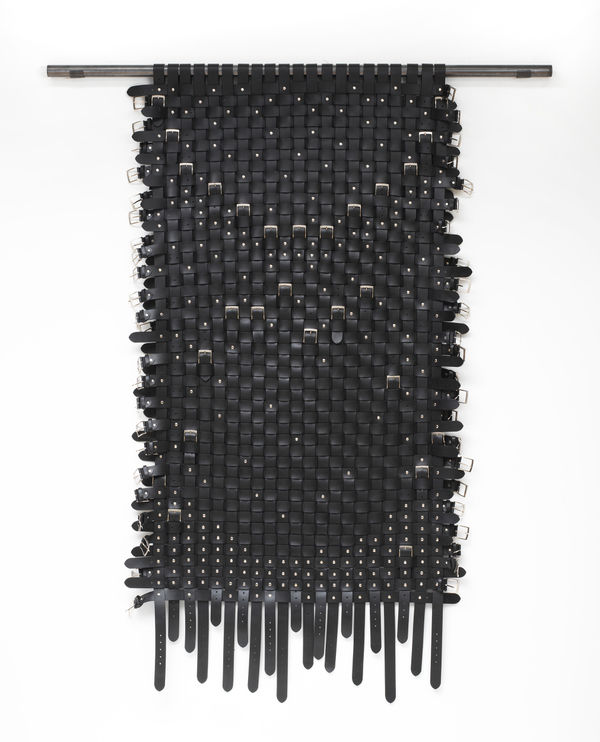
    image of monica's belt

    Among the most important artists of her generation, Monica Bonvicini’s evocative and thought-provoking sculptures, installations, texts, photographs, videos and public projects explore the relationship between architecture, gender and power. Monica Bonvicini’s series of woven leather belt works explore the cultural symbols of masculinity and discipline, and the compositions trigger a reflection on the threshold between pleasure and violence.

  • OLAFUR ELIASSON

    detail of eliasson painting

    Since 2009, Olafur Eliasson has been engaged in a project involving a new color theory based on the prismatic colors and explored through a series of painted artworks. He began these experiments by working with a color chemist to mix in paint an exact color for each nanometre of light in the visible spectrum, which ranges in frequency from approximately 390 to 700 nanometers. Since the initial experiments, Eliasson has used this palette to make paintings on circular canvases, known collectively as the Colour experiment paintings. Using this system, Eliasson has also created compositions that range from simple explorations of the spectrum to more complex efforts to capture the color in a specific source image. They are comprised of multiple layers of very thinly applied paint to create a seamless transition between colors. In Colour experiment no. 119 (Hekla), Eliasson captures and interprets the intersection of color and light within a specific photograph of the Icelandic volcano bearing that name.


    Using this largely grayscale color gradient as the background, Eliasson then places a piece of Icelandic sea ice, harvested from waters near his Reykjavik studio, at the center of the canvas, in an intentional gesture of experimentation. As the ice melts, the artist adds small quantities of pure pigment, which are carried across the canvas to create a new landscape of color fields. Formless blue and gray explosions spreads out from the center of the canvas, contrasting starkly with the even background. Metaphorically, the dematerialization of the ice, and its interaction with the color pigments illustrate the infinitely transitory nature of natural phenomena, as well as both the beauty and fragility of the landscape.

  • shilpa flapboard

    SHILPA GUPTA

    Often engaging with modes of transmission and amplification, Words Come from Ears is from a small series of flapboards which the artist has been working with since 2008. Returning to objects that inhabit entry–exit zones interrupting or flagging passage through borders and territory, Gupta’s turn to the flapboard, used traditionally to announce arrivals and departures, sets up a paradoxical experience of passive interaction. Invoking the ephemerality as well as cyclicality of longing, fulfillment and wait, typically associated with states of transition and change, the characters on the board display generate a series of short lines that change every few seconds eventually following a philosophical pattern, based on intuitive logic, that the viewer can speculate. The message is playful and portentous meditating on the something ‘as is’ as well as how it ‘is not’; for example, a poetic fragment announces ‘a confession’ immediately undercutting it as ‘not a confession’, and similarly the ‘now’ becomes the ‘not now’, etc. With these whimsical schematics, even in how many spellings are rendered, Gupta asks the viewer to rely on a hopeful intuition, to question the expected and understand the unexpected, which is often how the ‘other’ appears to us, in conversation with ourselves. As with some of her other works Gupta is concerned with the narcissism of seeing and cognition, and how constructed perceptions about the world are taken for granted as knowledge.

  • MARK MANDERS

    detail of manders face

    For more than three decades, Mark Manders has developed an endless selfportrait in the form of sculpture, still life, and architectural plans. Described by the artist as his ongoing “self-portrait as a building,” Manders’ works present mysterious and evocative tableaux that allow viewers to construct their own narrative conclusions and meanings. Initially inspired by an interest in writing and literature, Manders’ first conception of the self-portrait was more literal, employing language and the written word to describe his own narrative in an autobiography. Moving beyond the limits of language, he later began to explore the architecture of story telling, focusing on structure, rather than on specific content. This early realization resulted in his first sculptural investigations of form, meaning and narrative, which over the years have developed into a remarkable, and continually expanding body of work.


  • image of djurberg work

    NATHALIE DJURBERG & HANS BERG

    Nathalie Djurberg and Hans Berg’s new series of sculptural flowers offer a fragile beauty and an untamable, organic logic of their own. Constructed from mixed media – employing modelling clay, paint, fabric and resin – the sculptures recall real species of lilies or orchids, as well as fantastical floral arrangements in other-worldly colors and forms. Flowers recur in Djurberg & Berg’s practice due to their abiding interest in the fleeting nature of human emotions and their shared symbolism for human themes of love, joy, desire, sadness and vulnerability. Representing the circle of life, from a shy bud to a beautiful blossom to a withering plant, the flower form has been a constant interest in Djurberg and Berg’s practice.

    In 2009, the artists created their first major work inspired by flora and fauna, a subversively surreal and immersive Garden of Eden, entitled The Experiment, for the 53rd Venice Biennial, for which they were awarded the Silver Lion for best emerging artists.

  • ERNESTO NETO

  • neto detail image

    ERNESTO NETO

    Since the mid-1990s, Ernesto Neto has produced an influential body of work that explores constructions of social space and the natural world by inviting physical interaction and sensory experience. Drawing from Biomorphism and minimalist sculpture, along with Neo-concretism and other Brazilian vanguard movements of the 1960s & 70s, the artist both references and incorporates organic shapes and materials – spices, sand and shells among them—that engage all five senses, producing a new type of sensory perception that renegotiates boundaries between artwork and viewer, the organic and manmade, the natural, spiritual and social worlds.

  • lisa oppenheim detail

    LISA OPPENHEIM

    Lisa Oppenheim’s starting point for Goldener Apfelbaum (Version II) 1903/2023 is an image of a painting by the same title published in Gustav Klimt’s catalogue raisonné. The painting was seized from the collection of August and Serena Pulitzer Lederer by the Gestapo and later destroyed in a fire set by retreating German troops in Schloss Immendorf in Lower Austria in 1945. Oppenheim uses firelight to solarize the only known documentation image of Goldener Apfelbaum to create a new artwork that reimagines the painting through the element of its destruction.

  • ANALIA SABAN

    ANALIA SABAN

    Analia Saban dissects and reconfigures traditional notions of painting, often using the medium of paint as the subject itself. This body of work continues Saban's investigations into the relationship between paint, pigment and canvas. In this work, thin layers of dried acrylic paint is woven through the linen, physically embedded into the fabric of the painting.

  • saraceno detail email

    TOMAS SARACENO

    Tomás Saraceno is a multimedia artist who, for more than two decades, has produced a body of work that engages the interconnectedness of ecosystems. Saraceno created a new series of works titled ‘Cloud Cities: Species of spaces and other pieces’ for his current solo show at the Serpentine Galleries, London. A living sculpture series developed in consultation with a network of ornithologists, conservationists, and wildlife trusts to accommodate the dwindling numbers of birds, bees, butterflies, and spiders. Designed for multi species encounters, the work responds in material and atmosphere to the specific requirements of the species they mean to attract. Installed in the outdoors, this work will enact ways of cohabitation that better integrate human and other-than-human lives in a new urban setting

  • thomas scheibitz painting detail

    THOMAS SCHEIBITZ

    Among the leading German artists of his generation, Thomas Scheibitz has developed his own conceptual language that bridges the realms of figuration and abstraction, at times dissolving  them entirely. Drawing from classical painting and architecture, the contemporary urban landscape, and popular culture, Scheibitz deconstructs and recombines signs, images, shapes,  and architectural fragments in ways that challenge traditional contexts and interpretations. While centrally concerned with principles of classification and systems of order, the artist’s paintings, sculptures and works on paper resist traditional categorization.

  • sze detail image

    SARAH SZE

    Through complex constellations of objects and a proliferation of images, Sze expands upon the never- ending stream of visual narratives that we negotiate daily, from magazines and newspapers, television and iPhones, to cyberspace and outer space. This work evoke the generative and recursive process of image-making in a world where consumption and production are more interdependent, where the beginning of one idea is the ending of another— and where sculpture gives rise to images, and images to sculpture. Sze expands her work by embedding her nuanced sculptural language into the material surfaces of painting and into the digital realm— collapsing distinctions between two, three and four dimensions. Her practice fundamentally alters our sense of time, place, and memory by transforming our experiences of the physical world around us.


    Currently, Sarah Sze has a major solo exhibition at the Guggenheim Museum in New York.

  • wearing image

    GILLIAN WEARING

    Throughout the past two decades, Gillian Wearing has investigated public personas and private lives, and the ways in which individuals present themselves to others when the self is temporarily concealed.


    In this watercolor, Gillian Wearing references a painting of Saskia van Uylenburgh, Rembrandt’s wife. Rembrandt and Saskia married in 1634, and Saskia was the subject for several of the artist’s paintings. Similar to Gillian Wearing’s practice where she explores the personalities of different family members in her iconic Family Album series, Rembrandt’s series of paintings of Saskia explore several depictions of his wife’s personality. Here, Wearing recreates Rembrandt’s depiction of his wife and captures her warmth and softness before her death due to a debilitating illness in 1641.